
What is a B2B AI sales agent?
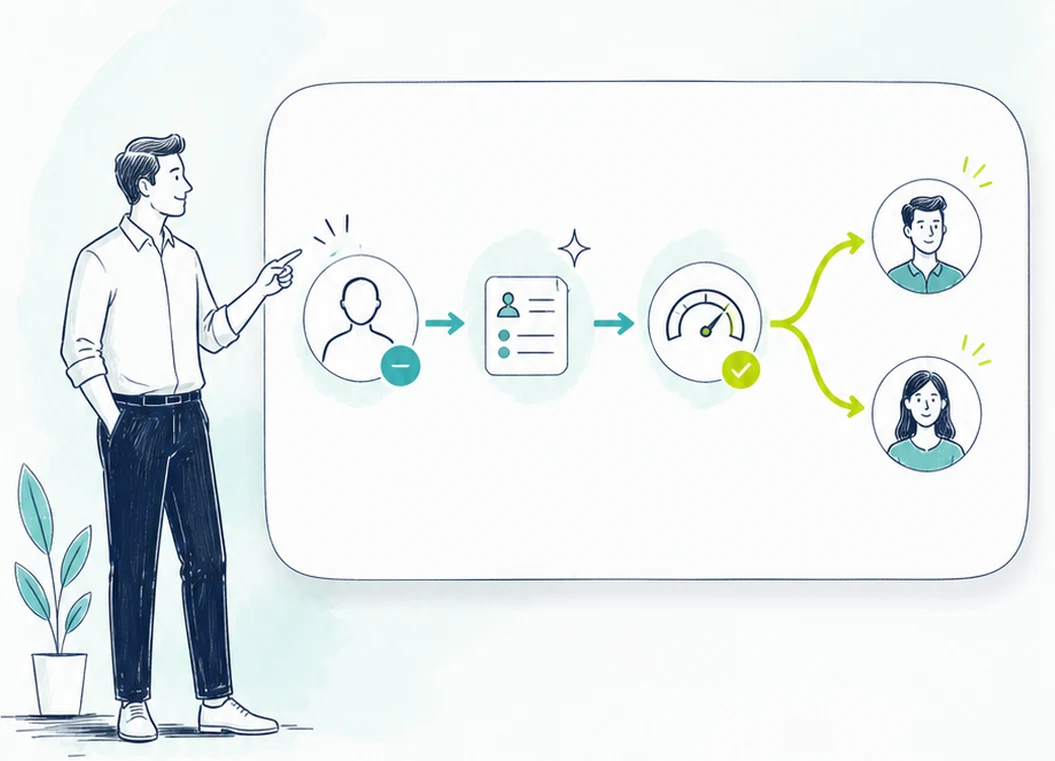
A B2B AI sales agent is a piece of software that handles a specific part of the sales process autonomously. The keyword is specific. The agents that work in production solve one job: qualify inbound leads, run an outbound prospecting sequence, follow up on no-shows, or manage the long tail of inactive deals. The agents that fail are the ones marketed as a complete AI salesperson that does everything.
Underneath, an AI sales agent is the combination of two layers. The first is LLM intelligence, the conversational and reasoning layer that reads the prospect's message, decides what to say, and writes a reply that sounds human. The second is a workflow automation layer that connects the LLM to the rest of the stack, your CRM, your calendar, your telephony, your data sources. Without the workflow layer the LLM is a clever chat that goes nowhere. Without the LLM the workflow is the same rules-based automation companies have been running since 2015.
Sales Surge runs its own AI SDR in production. The agent qualifies inbound leads on the website and via voice, books meetings directly into the founder's calendar, updates Pipedrive after every conversation, and escalates anything that scores hot to a human within minutes. It is not the only agent we have built, but it is the one we use on ourselves, which is the honest test. The agents we build for clients are scoped the same way: one job, one workflow, one measurable outcome.
AI sales agents, AI sales agent software, or an AI sales agent platform?
These three get used as if they mean the same thing, and they do not. The distinction matters because it decides what you are actually buying and what you still have to build yourself.
AI sales agent software is a product you license. It ships with an interface, a builder, and a set of connectors. AI sales agent platforms go one step wider: they promise a place to build many agents, with governance and monitoring around them. Both are containers. Neither is an agent. What makes something an agent is that it has one job, permission to act inside your systems, and a rule for when to stop and hand over to a human.
That is why the market for AI agents for sales looks so confusing right now. Most of what is advertised sits at the software or platform layer, so a demo shows you a builder rather than a working agent. The question that cuts through it is simple: can you see it change a real record in a real CRM, and can you see what it does when it is unsure?
- Software you license: gives you a builder. You still define the job, the data access and the escalation rules yourself.
- A platform: gives you a place to run several agents, plus monitoring. Useful at scale, overkill for your first agent.
- An agent: one job, write access to the CRM, a defined hand-over point. This is the part that produces the outcome.
- AI agents for sales automation: the same thing, framed around the workflow rather than the conversation. The test is identical.
- What to ask in any demo: show me the CRM record before and after, and show me a case where the agent decides not to act.
What can an AI sales agent actually do for a B2B company?
Below is the realistic capability list. Every item on this list is something Sales Surge has shipped to production for a paying B2B client.
- Qualify inbound leads via voice or chat 24/7. The agent picks up website chat or inbound calls, asks the qualifying questions your sales team would ask, and routes anything that meets the ICP straight to a meeting booking flow.
- Send personalised outbound sequences based on prospect data. Using enrichment from Apollo and signal data from LinkedIn, the agent drafts and sends sequences that reference real context, not generic templates. A human reviews exceptions, the agent handles the volume.
- Follow up on no-shows and inactive deals automatically. The agent watches Pipedrive for stalled deals and missed meetings, sends a context-aware reschedule message, and either books a new slot or moves the deal to a long-tail nurture if there is no response.
- Book meetings directly in the sales rep's calendar. Once a lead is qualified, the agent offers slots from the rep's real calendar, confirms the booking, sends the calendar invite, and logs the activity in the CRM with the full conversation transcript attached.
- Update the CRM automatically after each interaction. Every call, chat, email, and meeting updates the deal record with structured fields, not just a note dump. Stage changes, next-step dates, and qualification scores are written back without rep input.
- Escalate hot leads to human reps in real time. When the agent detects buying intent above a threshold (specific budget, timeline, or named competitor), it pings the rep on Slack or by phone within seconds so the human can take over while the lead is still warm.
What an AI agent cannot do (yet)
There is a version of the AI sales agent pitch that says you can replace your entire SDR and AE team. That version is wrong. Below is the honest list of what the current generation of AI agents cannot do well, and why a human salesperson still owns the high-stakes parts of the deal.
- Complex multi-stakeholder negotiation. As soon as the deal involves procurement, legal, and a buying committee with conflicting incentives, an AI agent cannot read the room. It does not know that the technical buyer secretly hates the incumbent or that the CFO will push back on a three-year term. A human reads those signals.
- Deep relationship selling. Enterprise B2B deals close because the buyer trusts the seller. Trust is built over months of conversations, dinners, and judgement calls in moments of conflict. AI agents cannot build trust at that depth, and prospects can tell within two messages whether they are talking to a human.
- Handling angry or upset clients. When a deal goes sideways, when a client feels misled, when an existing customer is about to churn loudly, the response has to come from a human with the authority to fix the problem. An AI agent in that moment makes things worse by sounding rehearsed.
- Strategic discovery on a brand-new product category. If the buyer does not yet know what they need, the conversation is consultative, not transactional. The agent does not have the lateral thinking to invent a solution shape that does not yet exist in its training data.
- Anything that requires accountability when it fails. If the agent commits to a price, a timeline, or a deliverable that the company cannot honour, somebody has to own it. The legal and reputational risk of an agent making promises sits with the human team, which is why the agent operates within tight guardrails.
AI agents are a force multiplier for volume and speed. They handle the top of the funnel and the long tail of follow-up at a scale no human team can match, and they free up your senior reps for the conversations that actually need human judgement. They are not a replacement for skilled salespeople. The companies getting real revenue impact from AI agents are the ones that scope the agent narrowly and keep the humans focused on the deals where humans win.
How Sales Surge builds AI agents
Sales Surge ships AI agents through a structured programme of 10 working days called the AI Sprint. Fixed price from €4,997, fixed scope, one focused agent live in production at the end of the second week. The Sprint format exists because most AI agent projects in the wider market run 3 to 6 months and produce a demo, not a working system. We compress the timeline by limiting scope to one agent and bringing the whole stack pre-integrated.
Berend de Visser is the live production example we point clients to. The AI agent we built handles inbound qualification, voice intake, calendar booking, and CRM sync end to end. The full case is documented separately, but the structural point is that the agent has been running in production for months without a senior rep babysitting it. That is the bar we build to, not a flashy demo that breaks under real load.
| Tool | Role | Why Sales Surge uses it |
|---|---|---|
| ElevenLabs | Voice synthesis and conversational voice agent layer | ElevenLabs produces voice quality that holds up on a real phone call. Prospects do not hang up because the voice sounds robotic. The latency is low enough for a natural back-and-forth, which is the threshold below which voice agents stop working. |
| CloudTalk | Telephony, call recording, and CRM-integrated call routing | CloudTalk handles the actual phone infrastructure: inbound and outbound numbers, call recording, and direct integration with Pipedrive. Calls handled by the agent log against the deal automatically, with the full transcript and recording attached. |
| Make.com | Workflow automation backbone connecting the LLM, CRM, calendar, and telephony | Make.com is the connective tissue. The LLM decides what to say, Make routes the data: writing back to Pipedrive, posting to Slack, triggering calendar invites, and handling the branching logic for escalation rules. Without this layer the agent is a chat without consequences. |
| Pipedrive | CRM source of truth for deals, contacts, activities, and routing rules | Pipedrive is where the agent reads the deal context and writes back the outcome. Every interaction, voice or chat, lands as a structured update on the deal record. Sales Surge is a Pipedrive Platinum Partner, so the integration depth is built in. |
The AI Sprint follows the same rhythm of 10 working days regardless of which agent we are building. Days 1 to 3 are design: the agent's job, the trigger, compliance, tone of voice, the success criteria and the escalation rules. Days 4 to 6 are build: message templates, the CRM integration and the dashboard. Days 7 to 9 are team training and testing against real scenarios pulled from your existing pipeline. Day 10 is go-live with a 90-day optimisation plan. Anything that does not fit the Sprint becomes a custom build with a 3 to 6 week timeline.
What does an AI sales agent cost?
AI agent pricing is straightforward when the scope is honest. The variables that move price are the number of integrations, the volume of conversations the agent has to handle, whether voice is in scope or only chat, and the depth of the qualification logic. Below is what a B2B company should budget for in the Netherlands and wider Europe.
AI Sprint (10 working days)
from €4,997
One focused agent, scoped, built, tested, and live in 10 working days, with 30 days of support. Includes ElevenLabs voice, CloudTalk telephony, Make.com workflow, and Pipedrive sync. Fixed scope, fixed price, no surprises.
Custom Agent Build
from €5,000
Multi-step agents, custom integrations beyond the standard stack, or agents that span more than one job. Pricing depends on complexity. Quoted after a 30-minute scoping call.
Monthly Maintenance and Iteration
from €500/month
Ongoing prompt tuning, new escalation rules, edge-case handling, model upgrades, and quarterly performance reviews. Most clients stay on this retainer because the agent keeps improving with usage data.
What pushes price up: voice over chat, multiple language support, integrations beyond the standard stack, and high conversation volume that requires dedicated infrastructure. What keeps price down: a single-language chat agent on the standard stack with one integration and a clearly defined qualification flow. Quotes far below this range usually mean a generic chatbot with an LLM bolted on, not a real workflow agent.
How long does it take to build and launch?
The default delivery format is the AI Sprint, five working days from kickoff to live in production. The day-by-day rhythm is below.
Day 1
DesignScope the agent's single job, define the trigger, agree the success metric, document the escalation rules, and lock the conversation flow on paper. The output is a one-page agent spec the client signs off on before any build starts.
Day 2 to 3
BuildThe Sales Surge AI engineer configures the LLM prompt, the Make.com workflow, the CRM sync, and the telephony or chat front end. The agent runs end to end in a staging environment by end of Day 3.
Day 4
TestingReal scenarios pulled from your existing pipeline are run through the agent. Edge cases get added to the prompt and workflow. The escalation path to a human rep is tested live. The agent does not move to Day 5 until the test scripts pass.
Day 5
Go-live and trainingThe agent goes live in production. The sales team is trained on how to handle the escalations and how to read the agent's CRM updates. Documentation is handed over in writing, and the maintenance retainer starts the following week.
Custom builds, agents that span more than one job or require integrations outside the standard stack, run on a 3 to 6 week timeline. The first week is still design. Weeks 2 to 4 are build. The remaining weeks are testing, integration hardening, and a phased rollout to the sales team. Anything beyond 6 weeks should be split into multiple agents rather than scoped as one.
Frequently asked questions
What does it cost to build an AI sales agent for a B2B company?
An AI Sprint, the standard build of one focused agent on the Sales Surge stack in 10 working days, is a fixed-price package from €4,997, including 30 days of support. A custom agent build, larger scope, multiple integrations, or multi-step logic, starts at €5,000 and is quoted after the scoping call. Ongoing maintenance and iteration starts at €500 per month and covers prompt tuning, new escalation rules, model upgrades, and quarterly reviews. Quotes well below this range usually mean a chatbot with an LLM front end rather than a workflow agent that updates your CRM and books real meetings.
How long does it take to build an AI sales agent?
The default Sales Surge delivery is an AI Sprint of 10 working days: days 1 to 3 strategy, compliance and tone of voice, days 4 to 6 message templates, CRM integration and the dashboard, days 7 to 9 team training and testing against real scenarios, day 10 go-live with a 90-day optimisation plan. Custom agents that span more than one job or require integrations outside the standard stack run 3 to 6 weeks. Anything beyond 6 weeks should be split into multiple agents instead of scoped as one, which is the most common reason AI agent projects fail in the wider market.
Can an AI agent replace my SDR team?
No, and any vendor saying yes is overselling. AI agents replace specific tasks, not the SDR role. The realistic outcome is that the agent handles inbound qualification 24/7, runs personalised outbound at volume, and follows up on no-shows and inactive deals automatically, which removes 60 to 80% of the admin and repetitive work from the SDR's day. The SDR then spends that time on the conversations that actually need a human, complex qualification, multi-stakeholder discovery, and the relationship work that closes deals. Companies that try to fully replace their SDR team with AI usually rehire within six months.
Which tools are used to build a B2B AI sales agent?
Sales Surge builds on a standard stack of ElevenLabs for voice synthesis, CloudTalk for telephony and call recording, Make.com as the workflow automation backbone, and Pipedrive as the CRM source of truth. The LLM layer is selected per use case (typically OpenAI or Anthropic models). The standard stack is what allows the Sprint timeline of 10 working days. Custom builds can swap in other tools, but the integration cost grows quickly outside the standard stack, which is why we recommend defaulting to it unless there is a hard reason not to.
What is the difference between an AI chatbot and an AI sales agent?
An AI chatbot answers questions inside a conversation window. The conversation ends when the user closes the tab and nothing happens afterwards. An AI sales agent is the chatbot plus a workflow layer that takes action: it writes back to the CRM, books a real meeting in a real calendar, escalates hot leads to a human rep on Slack or by phone, and triggers follow-up sequences if the conversation stalls. The chatbot is a conversation. The agent is a conversation that produces a measurable sales outcome.
What is the difference between AI sales agents and AI sales agent software?
Software is the thing you buy. An agent is the thing that does the work. Most tools sold as AI sales agent platforms are really a workflow builder with a language model attached, and they still need someone to define what should happen. A working agent is scoped around one job, has permission to write to your CRM, and knows when to stop and hand over to a human. If a demo cannot show you the agent updating a real deal record, you are looking at software rather than at an agent.
Do I need one AI agent or several?
Several, and smaller than you think. The pattern that works is one agent per job: one qualifying inbound, one chasing no-shows, one keeping the CRM clean. Each has a narrow instruction set you can actually test. The projects that fail are the ones that try to build one agent for sales and marketing at once, because the moment it misbehaves nobody can tell which of its nine responsibilities went wrong.
What does AI inbound sales look like in practice?
Inbound is where agents earn their keep first, because the work is high volume and time sensitive. The agent picks up the form fill or the reply, checks it against your qualification criteria, enriches it, writes the record in the CRM, and either books the meeting or routes it to the right rep with a summary. The measurable win is not usually a higher conversion rate. It is response time, from hours to minutes, on evenings and weekends included.
What makes B2B AI agents different from general sales AI?
B2B deals have multiple stakeholders, long cycles and a lot of context that lives outside the conversation. A general assistant that answers well in a chat window falls apart there, because it has no view of the account history, the open opportunity or who else is involved. A B2B agent has to read and write in the CRM, which is why we build them on top of the CRM rather than beside it.
How do I know if my sales process is ready for an AI agent?
Ask whether you could hand the task to a new hire with a written instruction. If yes, an agent can probably do it. If you cannot write that instruction down because it depends on judgement nobody has articulated, an agent will make that inconsistency faster rather than fix it. Automation is a multiplier, and pointing it at a process nobody agrees on multiplies the disagreement.